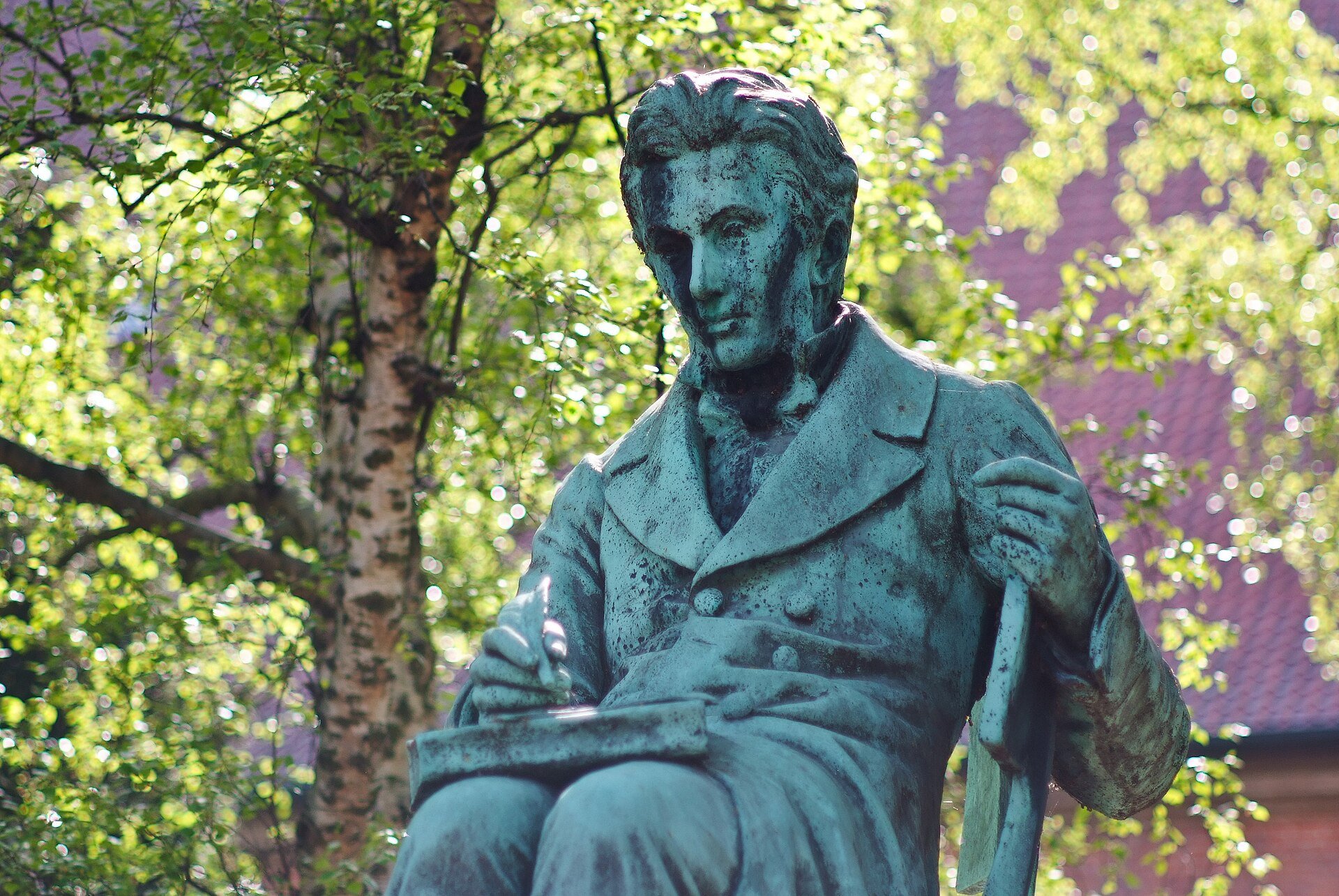
Devotion to Others: Fear and Trembling by Kierkegaard
Originally Published in the Kansas Government Journal – January/February 2026
This column may be a warning that it’s always best to listen to your team. As my deadline approached, I spoke with the rest of the League staff about topic ideas. They offered plenty of great options from the upcoming legislative session to the recent City Summit hosted by the National League of Cities (NLC). Yet I kept returning to Kierkegaard, the long-dead Danish theologian.
To be fair, Kierkegaard is simply the bridge between the NLC City Summit[1] and the service that our officials are providing at the local, state, and federal levels, but his writing is something worth considering. While I was at the NLC conference, I received an invitation from a former League colleague, Dr. Jonathan Fisk, to join his class as a guest lecturer. My conversation with students from the University of Utah's School of Public Affairs was a reminder about how critical it is that those in the public sector not only serve well but also prepare to wisely and thoughtfully hand the baton to those who are preparing to serve.
Jon has invited me to speak to his classes several times over the years. The first time, he asked me to “talk about my philosophy of leadership.” My immediate reaction was, “Well, first I need to figure out my philosophy of leadership.” It proved to be a worthwhile exercise, and one leadership value quickly rose to the top: prepare for my own obsolescence. The time we have is fleeting, so it is essential that we build up others to lead well when we’re gone.
Here is where Kierkegaard comes into play. In Fear and Trembling, he makes a profound observation:
If there were no sacred bond that united mankind, if one generation arose after another like the leafage in the forest, if the one generation replaced the other like the song of birds in the forest, if the human race passed through the world as the ship goes through the sea, like the wind through the desert, a thoughtless and fruitless activity…how empty then and comfortless life would be.[2]
Kierkegaard then contrasts a life focused on self with selfless devotion to others, arguing that the rewards of the latter are far greater.
When I joined Jon’s class in Salt Lake City, the students reminded me of how nourishing it is to pour time and energy into those who are interested in public service. As Kierkegaard noted, there is indeed a sacred bond that links one generation to the next. That bond carries an obligation to thoughtfully identify and nurture others in preparation for their pending responsibility.
Such preparation, however, can be one of the greatest challenges for those in public service. Those who are both willing and able to serve are also those who tend to be stretched most thinly. As the old proverb emphasizes, “if you want something done, ask a busy person.” This adage is certainly true for our elected officials, which makes it even more challenging to find time to build up others to serve.
Further, there is a natural pull to keep the positions we hold, a point illustrated by George Washington. In 1817, Congress commissioned John Trumbull to produce four paintings that portrayed the Revolutionary War. While the signing of the Declaration of Independence is the most famous, Trumbull felt most strongly about capturing Washington resigning his commission. He saw that moment as “one of the highest moral lessons ever given to the world.”[3] Prior to Washington’s resignation, King George III remarked, “If he does that, he will be the greatest man in the world.”[4] It is no small thing to hand over power to those who follow, but it is a critical part of a strong legacy.
This point became clearer during a conversation with a mayor from Florida at the NLC conference. He chose not to run for reelection after 20 years on the city council. I asked him if he had helped prepare a successor, and he commented that he decided to stay out of the race—a typical approach for many. Yet in an era where it is increasingly hard to find willing and able public servants, we should commit to intentionally preparing others to lead.
My dad once told me that a definition of wisdom is learning from someone else so you don’t make their mistakes. So it is with preparing others to lead. Kierkegaard wrote that “it is not what happens to me that makes me great, but it is what I do, and there is surely no one who thinks that a man became great because he won the great prize in the lottery.”[5] When a leader shares time, insight, and opportunity with others, the result does not guarantee greatness, but it does bestow a prize that makes greatness far more attainable.
It is telling that so many people who worked closely with Washington went on to prominence themselves. He took on a fatherly role with those around him, and intentionally prepared others for leadership. When I speak to officials at each level of government, there is a common chorus of love for community and a commitment to service. Within that shared commitment, we can almost hear Kierkegaard adding his own notes to the song—reminding us that this work is not just for ourselves but for those yet who will follow.
Footnotes
[1] NLC City Summit: Salt Lake City Utah, November 20-22, 2025," City Summit, National League of Cities, https://citysummit.nlc.org/.
[2] Søren Kierkegaard, Fear and Trembling, trans. Walter Lowrie (London: Everyman Publishers plc, 1994), 11.
[3] John Trumbull, The Resignation of General Washington, December 23, 1783, 1824–28, oil on canvas, Yale University Art Gallery, New Haven, CT, https://artgallery.yale.edu/collections/objects/124.
[4] Ron Chernow, Washington: A Life (New York: Penguin Press, 2010), 921.
[5] Kierkegaard, Fear and Trembling, 54.
Additional Notes from Fear and Trembling
Kierkegaard opens Fear and Trembling by critiquing the modern trends in philosophy because all the thinkers focus only on doubting all that is. He expressed concerns over those who would doubt everything, even to sensory perception and notes that everyone has faith in something. This seems particularly important to remember in a postmodern era.
The book begins with a story about a man who is enthralled by the story of Abraham preparing to sacrifice Isaac on Mount Moriah. The older he gets, the less he understands it, and Kierkegaard imagines a number of explanations for how the scenario played out both for Abraham and Isaac.
Kierkegaard observes that if there is only a mindless power rather than an intelligent God, then the world is only despair. He continues:
“If there were no sacred bond that united mankind, if one generation arose after another like the leafage in the forest, if the one generation replaced the other like the song of birds in the forest, if the human race passed through the world as the ship goes through the sea, like the wind through the desert, a thoughtless and fruitless activity, if an eternal oblivion were always lurking hungrily for its prey and there was no power strong enough to wrest it from its maw—how empty then and comfortless life would be.”
On Abraham: “Abraham believed, therefore he was young. For he who always hopes for the best grows old, and he who is always prepared for the worst grows old early. But he who believes preserves an eternal youth.”
Kierkegaard notes that the only way Abraham could so willingly sacrifice his son, Isaac, was if he was wholly enthralled in eye and heart with God.
Chapter 2 contrasts Abraham with the rich, young ruler that Jesus encountered. Even if the ruler had given up all his riches, he would not have been remembered in the same way as Abraham. There is no ethical obligation to one’s riches in comparison to the obligation of a father to his son. While riches may have been what the ruler most deeply cherished, it does not rise to the same level of sacrifice or dread.
I find Kierkegaard’s criticism of modern philosophy, devoid of faith, to be quite interesting: “I do not however mean in any sense to say that faith is something lowly, but on the contrary that it is the highest thing, and that it is dishonest of philosophy to give something else instead of it and to make light of faith. Philosophy cannot and should not give faith, but it should understand itself and know what it has to offer and take nothing away, and least of all should fool people out of something as if it were nothing.” Later Kierkegaard asks, “Why does one sometimes hear that people are ashamed to acknowledge that they have faith?” He considers it philistinism to look poorly on people of faith.
C.S. Lewis makes the argument that we should read old books because insights from another era provide a different perspective on the current age. With this idea in mind, Kierkegaard’s observations about 19th-century society present a striking contrast to our own. He notes: “What our age lacks, however, is not reflection but passion. Hence, in a sense, our age is too tenacious for life to die. For dying is one of the most remarkable leaps.” While Kierkegaard criticized an era of over-thinking and an absence of passion, our modern age seems to be the opposite: plenty of passion (or at least adherence to feelings) but not reflection.
Kierkegaard observed the following tendency that is still applicable today: “it is to be judged by the result.” He elaborates that “we are curious about the result, just as we are curious about the way a book turns out. We do not want to know anything about the anxiety, the distress, the paradox. We carry on an esthetic flirtation with the result. It arrives just as unexpectedly but also just as effortlessly as a prize in a lottery, and when we have heard the result, we have built ourselves up.”
So often in life, we focus entirely on the final outcome while ignoring the difficult process required to get there. Yet the results are often outside our control, so it is all the more important to prioritize character and integrity over victory, popularity, or political grains. When I think about this idea in relation to my kids, it is clear how difficult this lesson is to communicate. It is easy to see Patrick Mahomes or Caitlin Clark and think, “I want to be like that.” Yet seldom do people want to tirelessly put in the daily commitment that’s necessary to achieve greatness.
The same is true for character. Practicing the seemingly little things—like thoughtfulness, kindness, and honesty—is what builds the statesmanship we long to see from our leaders. As Kierkegaard noted when assessing our love of greatness, we may wish for the results to justify the means, but wishing does not make it so.
The results may not be what we want, but we can always choose to be people of character in how we conduct ourselves day to day and hour to hour. While it is easy to be captivated by high-profile success, a far better gauge of true excellence is an unwavering commitment to character—the real hallmark of greatness.
“For it is not what happens to me that makes me great, but it is what I do. And there is surly no one who thinks that a man became great because he won the prize in the lottery.” Both Abraham and Mary did not become great “because they were exempted from distress and torment and paradox but they became great through these.”
It is challenging to compare Kierkegaard’s “Knight of Infinite Resignation” (the person who is of upright character and ethics by resigning themself to loss so as to live a moral life) versus the “Knight of Faith” (the person who lives like the Knight of Resignation yet believes that all earthly sacrifices will receive back that which is sacrificed). Kierkegaard talks about the Knight of Faith returning to the universal. This is part of the paradox that Kierkegaard sees: the Knight of Faith lives beyond the earthly understanding of ethics (e.g. Abraham who can rightly resign himself to sacrificing his son) yet “returns to the universal” in a manner beyond existential isolation from society. So the Knight of Faith does not reject the earthly ethics but places a higher trust in following God’s plan. The Knight of Faith sees his wishes and duty as identical: following God in all things.
In Chapter 5, Problem III, Kierkegaard asks whether it was ethically defensible for Abraham to conceal his task from Sarah, Eliezer, and Isaac. I struggled with Kierkegaard’s usage of “aesthetics,” but it seems to mean the sensory perception of humans in relation to the pursuit of beauty, pleasure, and desires, yet not necessarily within the scope of ethical or religious implications. Ethics and religion may demand something else that does not seem reconcilable with aesthetics.
Ending: “And yet think what he attained. He remained true to his love. But he who loves God has no need of tears, no need of admiration. In his love, he forgets his suffering. Yea, so completely has he forgotten it that afterwards, there would not even be the least inkling of his pain if God himself did not recall it.”